INDUSTRY FOCUS
Dry Ice Cleaning for Flexographic Printing
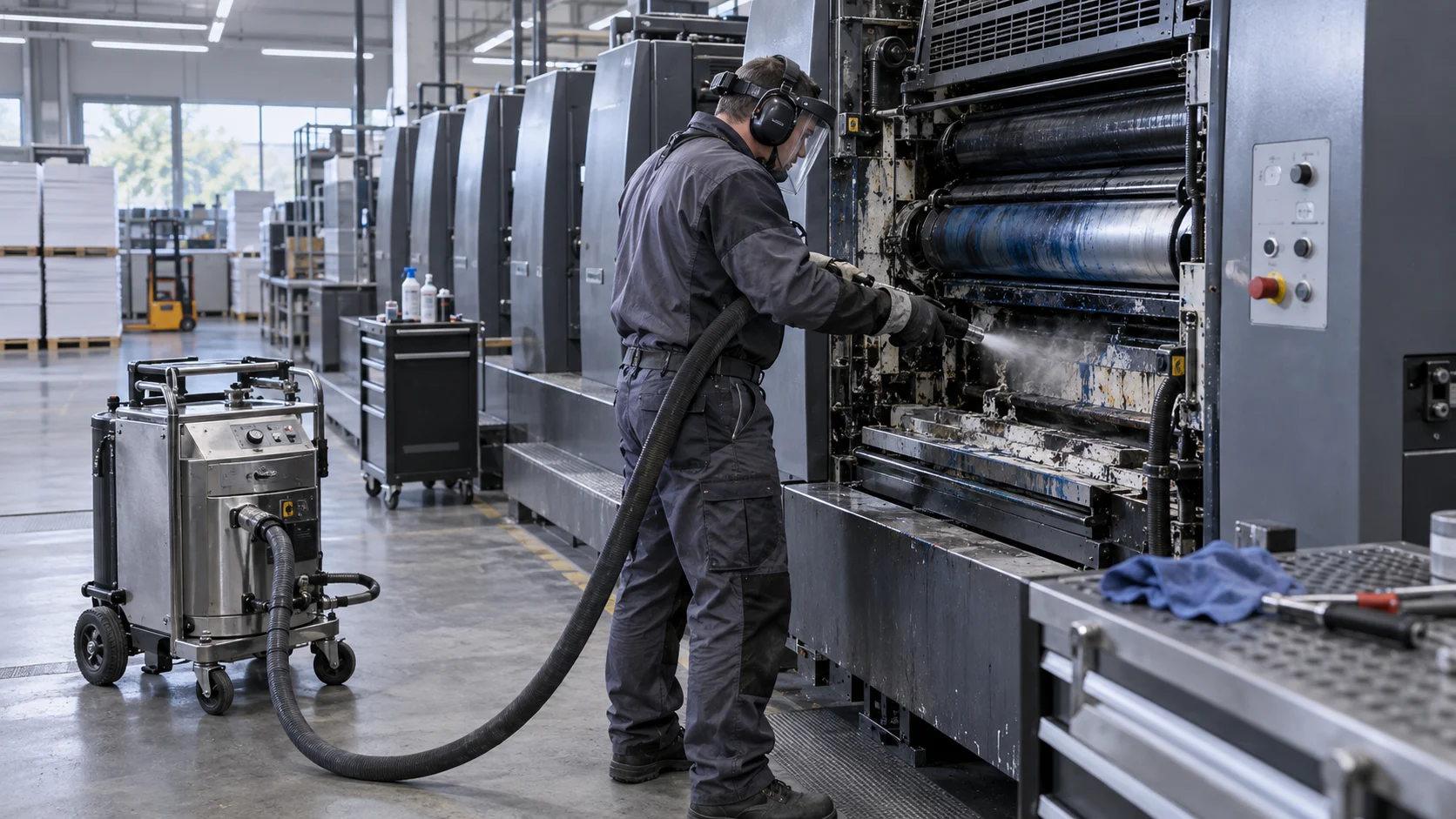
Flexographic press dry ice cleaning for ink and adhesive buildup on accessible press frames, guards and equipment surfaces.
Precision Dry Ice Cleaning provides flexographic press dry ice cleaning for ink and adhesive buildup on accessible press frames, guards and equipment surfaces.
Precision Dry Ice Cleaning accepts flexo-equipment inquiries from label, flexible-packaging, and corrugated-printing operations across NJ, NY, PA, and DE. Start with one press or a defined group of components rather than an unspecified whole-line cleanup.
Deposits removed from flexographic printing equipment
We remove dried ink, adhesive, varnish and attached paper dust from specified press frames, guards, trays and connected converting equipment. Water-based, solvent-based and UV-cured deposits are identified by station; precision rolls have their own cleaning scope.
Operational benefits
- Clear ink and adhesive from accessible press maintenance areas.
- Clean installed structural components during the press outage.
- Reduce repeated solvent wiping while keeping roller inspection and print checks explicit.
Non-toxic dry ice and eco-friendly cleaning benefits
Dry ice is a non-toxic cleaning medium. Dry ice blasting cleans with solid CO₂ and compressed air without detergents, solvents, wash water or added abrasive grit. Its environmental benefits include no chemical rinse water and no spent blasting media from the blasting step.
Food-grade dry ice is a food-safe cleaning medium used for food-processing equipment. Food-facility cleaning still follows the site’s sanitation, allergen-control and equipment-release procedures.
The dry ice turns into gas. Removed deposits still require collection, and ventilation and protective equipment remain part of the cleaning setup.
Match flexographic press cleaning to the component
Cold Jet’s printing guidance describes dry ice applications involving ink, adhesives, and production residue. The press manufacturer’s restrictions and the condition of the individual component determine what can be included in your project.
| Component to review | Define the work |
|---|---|
| Frames, guards and accessible side walls | Target ink or mixed deposits and identify the finish to retain. |
| Ink trays and removable collection parts | Identify ink chemistry, preparation and the agreed handback condition. |
| Anilox rolls and sleeves | Obtain roll-specific guidance and define cell inspection separately. |
| Accessible dryer housings and web-path supports | Confirm isolation, access and protection of sensitive components. |
| Connected converting equipment | Separate adhesive deposits and list the associated assets. |
Give anilox rolls their own scope
Use the dedicated anilox roller cleaning page for roll identification, manufacturer approval, and before-and-after inspection. A visibly cleaner surface is not a substitute for the cell-condition or volume check your print process requires.
Assign the measurements and the final production decision to named people. Keep roll handling, removal, replacement, and any supplier inspection separate in the proposal.
Identify the ink and adhesive system
State whether the line uses water-based, solvent-based, UV-curable, or another ink system. Supply the relevant product information and describe whether deposits are fresh, dried, cured, or mixed with paper dust and grease.
Mark the exact surfaces to retain and protect. Different deposits on the same press may need different methods. Do not assume that a result on one ink system applies to every station.
Use adhesive residue removal for glue deposits and packaging and converting equipment cleaning for related laminators, handling equipment, and accessible frames.
Fit flexographic press cleaning into the maintenance window
- List the press and stations available during the visit.
- Identify who removes guards, isolates the equipment, and prepares the work area.
- Confirm compressor access, air requirements, ventilation, and residue collection.
- Prioritize the components if the available window changes.
- Allow for reassembly, inspection, and the facility’s return-to-production checks.
Use shutdown cleaning planning for a larger stoppage. Cleaning while equipment remains installed does not mean operators should work on an energized or moving press.
Keep the first trial measurable
Select a deposit and component that represent the recurring problem. Photograph the starting condition and agree on the accepted result. Record the preparation, treatment boundary, cleanup, and inspection time as separate activities.
Use the result to refine the next scope. The time needed for one accessible guard should not become an unsupported estimate for an entire press.
Build a recurring pressroom scope
For repeat maintenance, retain a component list and consistent photo positions. Review the buildup at each visit and agree which tasks stay in the routine scope and which require a separate shutdown.
Coordinate cleaning with your established lubrication and maintenance procedures. Name the facility representative who accepts the cleaned area and the team that signs off print performance.
Flexographic press cleaning questions
Can you clean every part of the press with dry ice
Each component needs review. Rolls, seals, sensors, wiring, bearings, and coated surfaces should have explicit treatment or exclusion instructions.
Does the quote include press adjustments and print testing
Include any requested specialist checks in the scope review. Do not assume a surface-cleaning quote includes mechanical adjustment, color management, or production validation.
Prepare a flexo cleaning quote
Send the press model, ink system, component list, photos, and maintenance window. Review pricing factors and discuss a representative cleaning trial. The broader printing industry page and industry directory cover other production environments.
LET’S LOOK AT YOUR PROJECT
Need dry ice
cleaning?
Call for dry ice cleaning services in NJ, NY, PA, or DE. Tell us what needs cleaning and when you need the work done.
NY · NJ · PA · DE / Businesses and private owners