CLEANING APPLICATION
Printing Press Cleaning Services
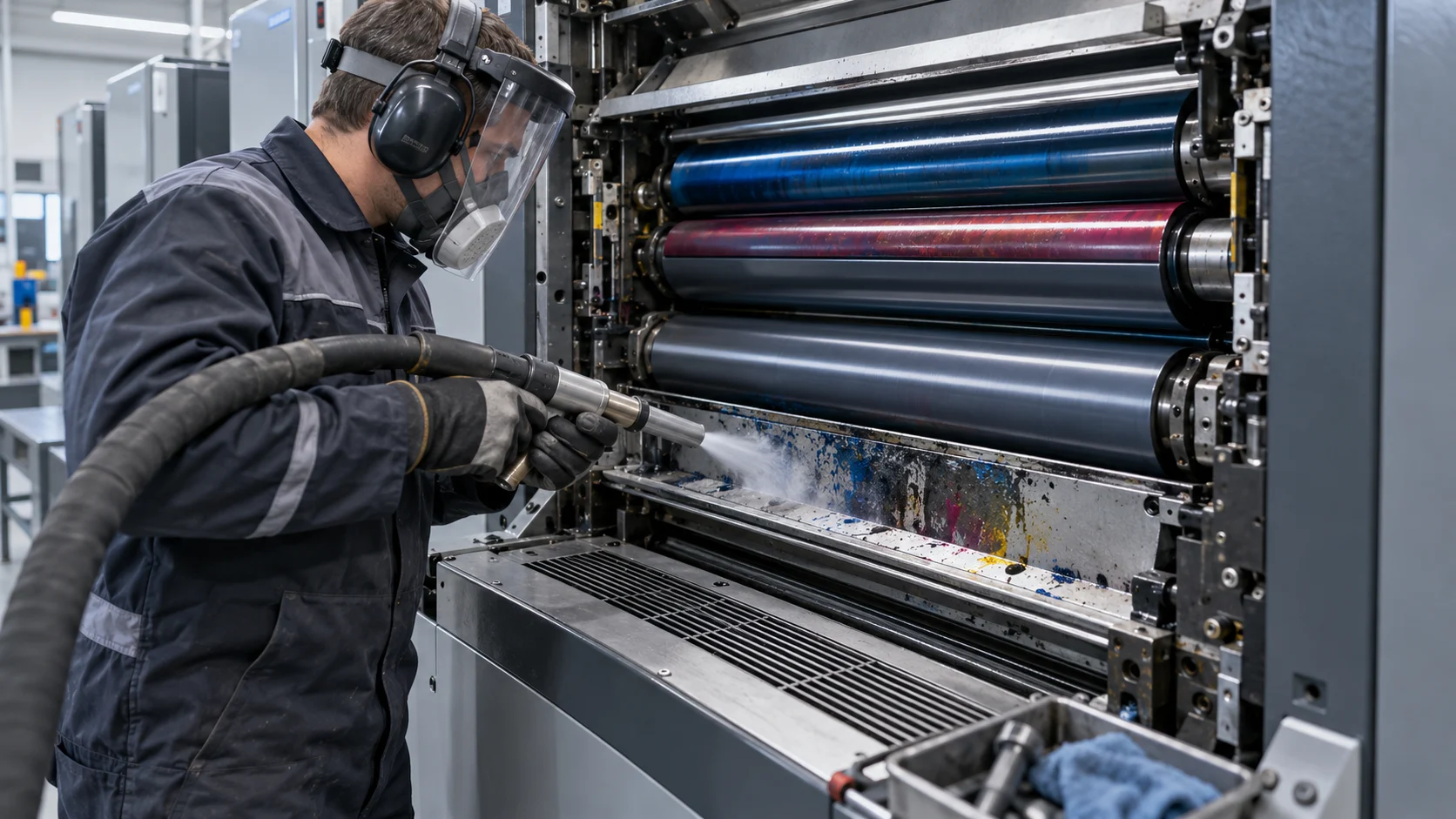
Our printing press cleaning services remove dried ink, grease and adhesive from press equipment. Schedule mobile dry ice blasting during maintenance in NY, NJ, PA and DE.
Printing press cleaning services by component
Precision Dry Ice Cleaning provides printing press cleaning services using mobile dry ice blasting for ink and production buildup on press frames, guards and accessible equipment surfaces. Schedule work during planned maintenance or a press outage. Precision rollers follow the equipment manufacturer’s cleaning requirements. Our on-site dry ice blasting services cover New Jersey, New York, Pennsylvania and Delaware.
Dry ice cleaning removes ink, grease and production residue from printing equipment without wash water or added cleaning solvents. Group press and roller cleaning within the maintenance window to reduce production interruptions. Assign access, preparation and handback duties with the press maintenance checklist.
Printing press cleaning services for ink and adhesive deposits
We remove dried ink, grease, adhesive and attached production residue from accessible press frames, guards, trays and equipment surfaces. Coated, rubber-covered and engraved rollers retain their own manufacturer-defined cleaning and inspection requirements.
Operational benefits
- Clear accessible press components for maintenance inspection.
- Clean installed structural surfaces within the planned press outage.
- Reduce solvent wiping while keeping precision-roll inspection and print verification separately assigned.
Non-toxic dry ice and eco-friendly cleaning benefits
Dry ice is a non-toxic cleaning medium. Dry ice blasting cleans with solid CO₂ and compressed air without detergents, solvents, wash water or added abrasive grit. Its environmental benefits include no chemical rinse water and no spent blasting media from the blasting step.
The dry ice turns into gas. Removed deposits still require collection, and ventilation and protective equipment remain part of the cleaning setup.
Printing press cleaning services during maintenance stops
Our printing press cleaning services remove dried ink, grease, adhesive and production deposits from press frames, guards, trays and surrounding machinery. Dry ice blasting uses no wash water or added cleaning solvents. Schedule the press components together within the available maintenance stop.
Send the press model, ink system, photos of the buildup and the components to be cleaned. Identify precision rollers separately so their manufacturer requirements and inspection steps remain clear.
Send press photos for a cleaning quote. For local work, see printing equipment dry ice blasting in New Jersey.
For a flexo pressroom, see flexographic printing equipment cleaning for the press components, ink system and converting tasks to include in the maintenance visit.
Remove dried ink from press structures and precision rollers
Dry ice blasting removes dried ink, grease and adhesive deposits from press structures without wash water or added cleaning solvents. Identify press frames, ink trays, coated rollers and anilox cells separately. Each precision roller follows its manufacturer-defined cleaning, inspection and restart requirements.
For the maintenance sequence and alternatives to solvent wiping, see removing ink buildup from printing equipment. For engraved cells, see anilox roller cleaning. Get a printing press cleaning quote with the press model, ink chemistry, and component list.
Flexographic presses and roller surfaces
For a flexographic press, include the press model, the ink system, and the components needing cleaning. Identify anilox, rubber-covered, ceramic-coated, or other precision rollers separately.
Provide close-ups and the manufacturer’s cleaning guidance. If the objective concerns anilox-cell condition or ink-transfer performance, state the required inspection or measurement. A visual cleaning result alone does not establish roller capacity or print performance.
Schedule printing press cleaning services
List which guards, trays, or components your team will remove and when the press can be isolated. Identify nearby web paths, ink systems, sensitive components, and surfaces excluded from the work.
Include the unloading route, workspace, compressed-air information, and collection of dislodged deposits. Coordinate the proposed cleaning window with maintenance and production staff.
Test and document the application
Choose a representative component or area and agree on the intended condition after cleaning. Record the residue, substrate, preparation, and inspection points before the test.
Separate cleaning from roller repair, recoating, mechanical adjustment, and print-process verification. Identify who performs any checks needed before the press returns to production.
Connect press cleaning to repeat maintenance
The printing industry page connects press cleaning with routine maintenance. Use packaging equipment cleaning for related converting equipment and adhesive residue removal for adhesive deposits.
Review scheduled cleaning and project pricing using a defined press and component list. Discuss a test cleaning when residue or surface response needs evaluation.
Bergen County pressroom projects
For a Bergen County pressroom, review local printing-press cleaning and prepare a press-by-press list of ink deposits, rollers and access restrictions.
Printing press cleaning services questions
Can every press roller use the same cleaning scope?
Identify anilox, rubber-covered, ceramic-coated and other precision rollers separately. Their manufacturer requirements and inspection criteria are different from general press-frame cleaning.
Does a clean-looking roller confirm print performance?
Keep visual cleaning acceptance separate from anilox-cell measurement, roller capacity, and print-process verification. State which inspection or measurement your team requires and who completes it before the press returns to production.
What information is needed for a press cleaning quote?
Provide the press model, ink system, component list, photographs, and available cleaning window. Identify guard removal, isolation, nearby sensitive parts, compressed air, and residue collection. Use those details to request printing equipment dry ice cleaning.
For a related equipment scope, review our printing press maintenance cleaning service page. It explains the surfaces, work window, and details to include in a project request.
Process reference: Cold Jet application guidance.
LET’S LOOK AT YOUR PROJECT
Need dry ice
cleaning?
Call for dry ice cleaning services in NJ, NY, PA, or DE. Tell us what needs cleaning and when you need the work done.
NY · NJ · PA · DE / Businesses and private owners