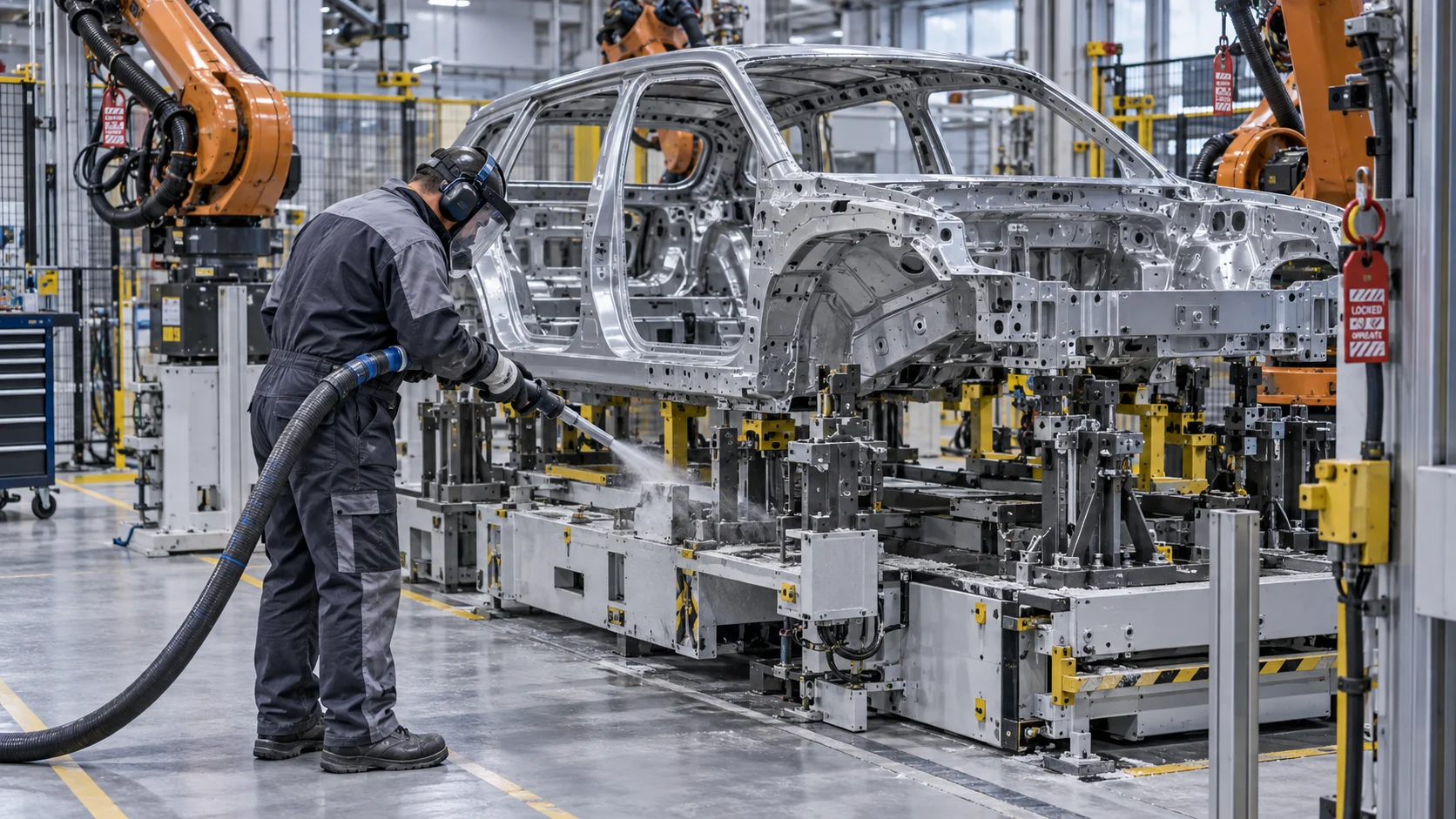
INDUSTRY FOCUS
Dry Ice Cleaning for Automotive Manufacturing and Suppliers
Automotive manufacturing dry ice cleaning for tooling, fixtures, and production equipment in NY, NJ, PA, and DE. Plan a test or maintenance visit.
Automotive manufacturing dry ice cleaning supports a defined cleaning scope for production tooling, fixtures, and accessible equipment. Precision Dry Ice Cleaning serves manufacturers and suppliers across New York, New Jersey, Pennsylvania, and Delaware. Discuss one tool, a production cell, or a coordinated maintenance visit.
This page addresses manufacturing equipment. For a privately owned vehicle or a workshop project, use automotive dry ice cleaning. A production tool, a welding fixture, and a vehicle engine bay need different work scopes and inspection points.
Automotive manufacturing dry ice cleaning applications
Dry Ice Energy’s automotive industry guidance identifies tooling, fixtures, and robotic equipment among manufacturing applications. Use your production process to narrow that broad category to the surfaces and deposits that matter at your facility.
Tell us what the equipment produces, which material or release system it uses, and where buildup occurs. Include the current cleaning method and the practical problem your team wants addressed. That might be a difficult access point, a recurring deposit, or a cleaning task that must fit a short maintenance window.
Plastic injection tooling and molded components
For injection tools, identify cavities, parting lines, vents, inserts, and areas with a specified finish. Provide the mold material, coating details, and the processing residue to remove. Mark repaired areas and sensitive features before planning a test.
Use our plastic injection mold cleaning service for the detailed tooling scope. Define whether the tool remains in the press or is available on a bench. Include the handling and inspection duties assigned to your team.
Rubber tooling and sealing-product production
For rubber molds, describe the compound, release product, operating conditions, and deposit pattern. Separate the mold face from surrounding equipment. A repeat-cleaning requirement should identify the same surfaces on each visit.
The rubber mold cleaning page explains the project information needed. Use a representative test when the deposit or finish response is uncertain. Keep mold repair and dimensional inspection as separately assigned work.
Foundry and die-casting tooling
For core boxes, dies, or selected foundry tooling, identify the process and residue. Distinguish material on the tool from fused metal, scale, or damage that may require another process. Include photographs showing both the deposit and its surrounding surface.
Our foundry tooling service provides the appropriate starting point. Connect related machine frames and equipment surfaces to a wider visit only after defining their own cleaning boundaries.
Fixtures, robotic cells, and support equipment
For welding fixtures and robotic equipment, list locating surfaces, accessible housings, and areas with process buildup. Identify protected cables, seals, labels, sensors, and coated components. Your technical team should provide the equipment restrictions.
Use weld fixture and robotic equipment cleaning to define this work. Keep robot programming, calibration, electrical servicing, and equipment repair outside the cleaning task unless separately assigned to qualified personnel.
Match the cleaning objective to the production process
Give each asset an outcome that can be inspected. Examples include removing a selected release-agent deposit, exposing a fixture surface for maintenance inspection, or cleaning accessible machine housings. Avoid an open-ended instruction to make an entire cell look new.
Where a deposit is associated with a production problem, record that observation without treating cleaning as the diagnosis. Your engineering or maintenance team should determine the cause and any necessary correction. The cleaning scope should state what material is to come off and what surface must remain.
This approach also helps compare proposals. Ask each contractor to quote the same asset list, access arrangements, protection, and collection work. Our quote comparison guide explains the information to keep consistent.
Plan installed-equipment access and isolation
Identify the points where the cleaning team can reach the surface. Provide the available work envelope, guard-removal arrangements, and the time each asset can be released. Installed equipment may still require selected components to be removed for access.
Connect the visit to your site’s isolation and work-permit process. Include nearby production cells that must remain separated from the cleaning area. Review air supply, ventilation, residue handling, and hearing protection within the facility requirements.
For electrical assets, use the electrical equipment cleaning scope. That service is planned around de-energized equipment and the equipment owner’s inspection process.
Set the test and production handback criteria
Choose a trial area with the actual deposit and finish. Agree on the cleaning boundary, the features to preserve, and the inspection method before work starts. Record the response before extending the scope.
A tooling inspection may require more than a visual check. Identify any dimensional, coating, surface, or process verification that your team requires. Assign who accepts the cleaned asset and who authorizes its return to production.
For composite tooling within an automotive supply operation, also review composite tool cleaning. Keep release-system changes, recoating, and repair attached to their own specifications.
One project or recurring supplier maintenance
A first visit can establish the work needed for a defined asset list. Use that baseline to plan future cleaning, while recording changes in production hours, compounds, release agents, and deposit condition.
For several cells or facilities, list the site contact and working window for each location. Coordinate access with the people who control the equipment. Our maintenance service and plant shutdown cleaning page explain the two planning routes.
Questions from automotive manufacturers
Can molds and robotic equipment share a visit?
Yes. Submit them as separate tasks within one equipment list. Each task should retain its own access requirements, protected surfaces, and inspection criteria.
Can a trial establish the whole project price?
A representative trial can inform the scope and time allowance. Differences in deposit thickness, access, or surface condition still need to be reflected in the final proposal.
What should a supplier send first?
Start with the site ZIP code, process, equipment type, deposit, and preferred window. Include photographs and the relevant manufacturer restrictions when available.
Request a manufacturing project review
Request a project review for automotive manufacturing dry ice cleaning in NY, NJ, PA, or DE. Read building a cleaning scope for molds, fixtures, and robotic cells to prepare an equipment list your production and maintenance teams can use.
Prepare the equipment list with the automotive molds, fixtures, and robotic-cell planning guide. Connect the selected tasks to recurring maintenance or a planned shutdown, and use the site setup checklist to record shared requirements.
Process reference: Application reference. Project suitability requires a separate assessment.
LET’S LOOK AT YOUR PROJECT
Ready for a
cleaner starting point?
Call to discuss your equipment, cleaning goals, and preferred dates. Have a shutdown planned? Start the scope review before your maintenance window is finalized.
NY · NJ · PA · DE / Businesses and private owners