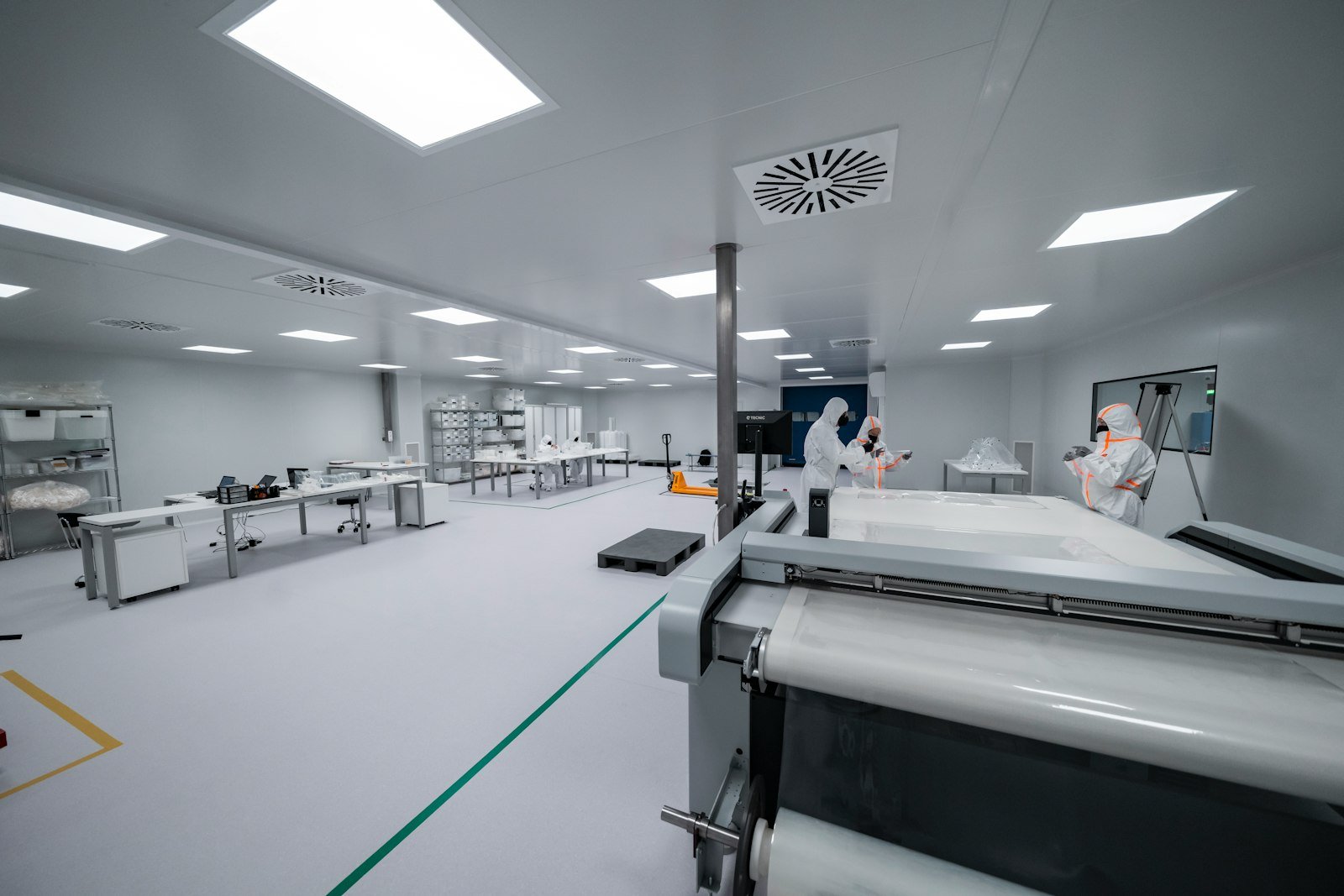
INDUSTRY FOCUS
Cleanroom Equipment & Surface Dry Ice Cleaning
Remove release-agent buildup, adhesive, grease and production residue from cleanroom equipment, tooling and surfaces under your facility’s contamination controls.
Deposit removal for controlled manufacturing environments
Precision Dry Ice Cleaning removes release-agent buildup, adhesive, grease, oil and production residue from cleanroom manufacturing equipment, molds, fixtures and accessible support surfaces. We provide on-site service across New Jersey, New York, Pennsylvania and Delaware.
Dry ice blasting cleans with solid CO₂ that turns into gas. It introduces no wash water or spent abrasive grit. The material removed from the equipment remains waste, so capturing that material is a central part of cleanroom work.
Deposits removed from cleanroom equipment and tooling
We remove release-agent films from mold faces, adhesive from fixtures, and grease and oil from accessible machine frames and support surfaces. Released deposits are captured within the controlled cleaning zone.
Operational benefits
- Clear tooling details and fixture surfaces for maintenance inspection.
- Clean without introducing wash water or abrasive grit into the work zone.
- Complete the defined deposit-removal step before facility verification and area release.
Non-toxic dry ice and eco-friendly cleaning benefits
Dry ice is a non-toxic cleaning medium. Dry ice blasting cleans with solid CO₂ and compressed air without detergents, solvents, wash water or added abrasive grit. Its environmental benefits include no chemical rinse water and no spent blasting media from the blasting step.
Food-grade dry ice is a food-safe cleaning medium used for food-processing equipment. Food-facility cleaning still follows the site’s sanitation, allergen-control and equipment-release procedures.
The dry ice turns into gas. Removed deposits still require collection, and ventilation and protective equipment remain part of the cleaning setup.
Equipment, tooling and surfaces we clean
- Production molds and tooling: cavities, vents, parting lines and accessible tool details with release-agent or process buildup.
- Assembly fixtures and jigs: adhesive residue and deposits on accessible fixture surfaces.
- Production machinery: frames, guards, housings and other accessible surfaces with grease, oil or process residue.
- Packaging and handling equipment: adhesive buildup on guards, guides and equipment exteriors.
- Support surfaces: equipment stands, worktable frames, pipe exteriors and accessible metal surfaces within the agreed cleaning zone.
Related services include medical-device production equipment and tooling cleaning, pharmaceutical manufacturing equipment cleaning and electronics manufacturing equipment cleaning.
Capture residue at the cleaning area
We plan the cleaning sequence with your engineering and quality contacts. Define the source of the residue, the surfaces to clean, nearby product and the route for removing waste. Local capture and facility-approved containment keep the cleaning task focused on the equipment.
Where the facility requires HEPA-filtered capture, include it in the work instructions along with waste transfer, protection of adjacent surfaces and final cleanup. Dry ice disappearing after impact does not mean the removed contamination disappears.
Work within your cleanroom procedures
Room entry, gowning, material transfer, permitted cleaning methods and equipment isolation follow the facility’s procedures. The work plan also addresses compressed-air cleanliness, ventilation, CO₂ monitoring and the protection of sensitive components.
For tooling, record the finish and critical details to preserve. Where a cleaning method needs qualification, establish the approved parameters and acceptance criteria through your facility’s engineering and quality process.
Your quality team controls required residue testing, environmental checks, sanitation or sterilization, and release of the equipment or room. We provide deposit-removal cleaning within that plan; cleanroom certification and process validation remain facility responsibilities.
Plan cleaning around production
A visit can cover one mold, a fixture set, a production cell or an equipment list during a planned shutdown. Build the schedule around when each asset can be isolated, opened for access, cleaned and inspected.
For recurring maintenance, tie the cleaning interval to deposit accumulation and the facility’s approved procedure. Keep the equipment list and cleaning boundaries consistent so maintenance, engineering and quality teams have the same instructions.
Mold cleaning within the controlled-area work plan
Group medical-device production tooling, injection molds and fixtures into the equipment list. Include access to cavity faces, core pins and vent areas, plus any restrictions on polished surfaces.
Keep compressed-air quality, residue capture and CO2 ventilation within the facility’s approved work plan. Dry ice sublimation does not remove the production deposits from the room. Read polished tooling cleaning for the related surface details.
Cleanroom cleaning questions
Is dry ice blasting used in cleanroom manufacturing?
Yes. Cold Jet documents dry ice cleaning applications in medical manufacturing cleanrooms. Each facility controls approval of the method for its own equipment and process.
Does the service include cleanroom certification?
The service is equipment and surface deposit removal. Cleanroom classification, certification, cleaning validation and product release are managed through your facility’s quality program.
Does dry ice cleaning sterilize the equipment?
Sterilization is a separate process. Any required sanitizing or sterilizing follows your approved procedure after deposit removal.
Request cleanroom dry ice cleaning
Send the equipment photos, target deposits, facility location and cleaning window. Include the room-entry rules, contamination controls and required handoff documentation. Request a cleanroom cleaning quote or call 917-695-9595.
Read Contamination Controls for Cleanroom Dry Ice Cleaning for a practical planning guide.
Process reference: Application reference.
LET’S LOOK AT YOUR PROJECT
Need dry ice
cleaning?
Call for dry ice cleaning services in NJ, NY, PA, or DE. Tell us what needs cleaning and when you need the work done.
NY · NJ · PA · DE / Businesses and private owners