Planned vs Unplanned Plant Shutdown Costs and Where Cleaning Fits
Published · Updated
Compare planned and unplanned plant shutdown costs with a practical budget, a hypothetical example, and guidance on where dry ice cleaning fits.
Compare planned vs unplanned plant shutdown costs from equipment release through production restart. Include cleaning, support work, lost output, and inspection. Then account for the cost of getting the line running again.
Use this guide to build a budget for your plant. The industry figures link to their sources. The worked examples use clearly labeled hypothetical inputs. Convert budget priorities into an equipment list with the shutdown cleaning scope checklist.
A planned shutdown is a scheduled stop for defined work. An unplanned shutdown begins with an unexpected interruption. For a useful comparison, give each scenario its own scope, duration, and cost assumptions. Then identify which parts of the budget the cleaning method can actually influence.
Start with our plant shutdown cleaning service if you already have an outage scheduled. Use this article to prepare the financial questions for your maintenance and operations teams.
What to include in plant shutdown costs
First, use the same cost headings for both scenarios. Replace the prompts below with your plant’s records, supplier quotes, and production plan. Also mark unknown amounts as estimates until the responsible team confirms them.
| Cost category | Planned shutdown budget | Unplanned shutdown review |
|---|---|---|
| Production impact | Check the output displaced by the chosen maintenance window. | Check the output interrupted and whether it can be recovered. |
| Cleaning and maintenance | Price the defined asset list and work scope. | Separate cleaning, fault diagnosis, and repair charges. |
| Labor and contractor support | Confirm crew hours, access work, and any overtime. | Record additional hours, callouts, and waiting time. |
| Parts and logistics | Confirm availability and delivery before the outage. | Record emergency parts and expedited delivery where applicable. |
| Inspection and restart | Allow for acceptance, checks, and return to service. | Record recovery work, rework, and additional restart checks. |
| Customer commitments | Check the planned effect on promised deliveries. | Record actual expedites or contractual costs, where applicable. |
Published plant shutdown costs show the scale
Siemens’ The True Cost of Downtime 2024 reports the following hourly unplanned downtime costs. The report says its survey data comes mainly from large manufacturers and major industrial producers. See the report, pages 2, 4, and 7.
| Manufacturing sector | Reported cost per hour |
|---|---|
| Fast-moving consumer goods | $36,000 |
| Large automotive plants | $2.3 million |
These sector figures come from a 2024 report and cover several types of downtime cost. However, each plant needs its own cost estimate. The contribution-margin model below measures one part of that total, so the figures use different cost bases.
Next, use your plant’s output, margin, schedule, and event records to assess the potential loss. For example, does the stop affect one machine, a key line, several linked lines, or the whole plant?
Plan plant shutdown costs before choosing a date
First, define the work package. List the assets, deposits, cleaning result, access requirements, and required handback time. Ask each contractor to identify what their price includes and what depends on the facility.
Next, connect the work package to the production plan. Check whether the chosen period displaces customer orders, uses spare capacity, or requires a later recovery shift. Do not assign the same production loss to every hour just because equipment has stopped.
For the cleaning allowance, include setup, compressed air, dry ice supply, access equipment, residue collection, and inspection responsibilities. Check our dry ice blasting pricing guidance and guide to comparing cleaning quotes when defining the scope.
Also keep a separate allowance for unexpected work. State what it covers and who can approve its use. After the shutdown, compare actual spending with the budget. Then record how much of the allowance remains.
Reconstruct the full cost of an unplanned stop
For an unexpected outage, build a timeline from the first stop through stable production. Include diagnosis, waiting for parts or access, cleaning, repairs, inspection, and restart. Then use work orders and production logs to find which steps extended the outage.
First, ask the operations team whether it made up the lost output. Next, have purchasing list emergency freight and extra parts costs. Finally, ask quality staff to record scrap and rework caused by the event.
However, keep the cause of the breakdown separate from the cleaning scope. Cleaning during a repair does not prove that dirt caused the failure. It also does not prove that earlier cleaning would have avoided the breakdown.
Calculate plant shutdown costs without double counting
First, agree on a costing method with your finance team. This simple model uses contribution margin to value output your plant cannot recover. In other words, take the lost sales value and subtract the variable costs the plant avoids by not making those units.
Simplified production impact = unrecovered productive hours × contribution margin per productive hour.
If the plant can make up the output, estimate the extra cost of making and delivering it later instead. For example, check overtime, extra shifts, urgent freight, and confirmed penalties. Do not count the same units as both lost sales and sales the plant recovers.
Then add direct event costs that your hourly figure excludes. Check labor, contractor charges, parts, cleanup, and restart losses for overlap. A fully loaded downtime rate may already contain some of these items.
Plant shutdown costs at $25,000 per hour
Hypothetical production-loss example. Assume a line loses $25,000 of contribution margin for each productive hour the plant cannot recover. We use this input to test how the budget changes. It is not a customer result or an industry average.
For example, imagine a line makes 5,000 saleable units per hour. Each unit provides $5 of contribution margin. Together, those hypothetical inputs give $25,000 per hour. Replace both inputs with figures your finance team approves for the actual line.
Assume the planned scenario displaces four productive hours and the unexpected scenario displaces ten. This compares two illustrative durations without attributing their difference to cleaning.
| Production-loss input | Planned scenario | Unexpected scenario |
|---|---|---|
| Unrecovered productive hours | 4 hours | 10 hours |
| Assumed contribution margin per hour | $25,000 | $25,000 |
| Modeled production loss | $100,000 | $250,000 |
As a result, the six-hour difference represents $150,000 in hypothetical production loss. This is one part of each event’s budget. Next, add actual cleaning quotes, repair costs, support work, and restart costs. Check for items the margin calculation already includes.
For direct costs, get a quote based on the asset list, crew, shifts, access, and required cleaning result. Also record emergency freight, scrap, and restart costs for the specific job. This example uses no generic cleaning allowance.
The calculation assumes the plant cannot make up the output later. However, work may fit within an unused shift. The plant may also recover output without delaying other orders. In either case, adjust the production-loss estimate.
Test how the hourly assumption changes the exposure
Hypothetical sensitivity analysis. Each row uses the same four-hour and ten-hour scenarios. We selected these inputs to compare the effect of different hourly margins. They are not industry averages.
| Assumed margin per hour | 4 hours lost | 10 hours lost | 6-hour difference |
|---|---|---|---|
| $10,000 | $40,000 | $100,000 | $60,000 |
| $25,000 | $100,000 | $250,000 | $150,000 |
| $50,000 | $200,000 | $500,000 | $300,000 |
Therefore, compare these scenarios using the same costing method. Do not add a published total downtime rate to a separate production-loss estimate for the same hours.
Finally, record how often you expect each event to occur and what evidence supports any proposed change. This comparison does not establish that cleaning would avoid a breakdown or recover the six-hour difference.
Where dry ice cleaning fits in the shutdown budget
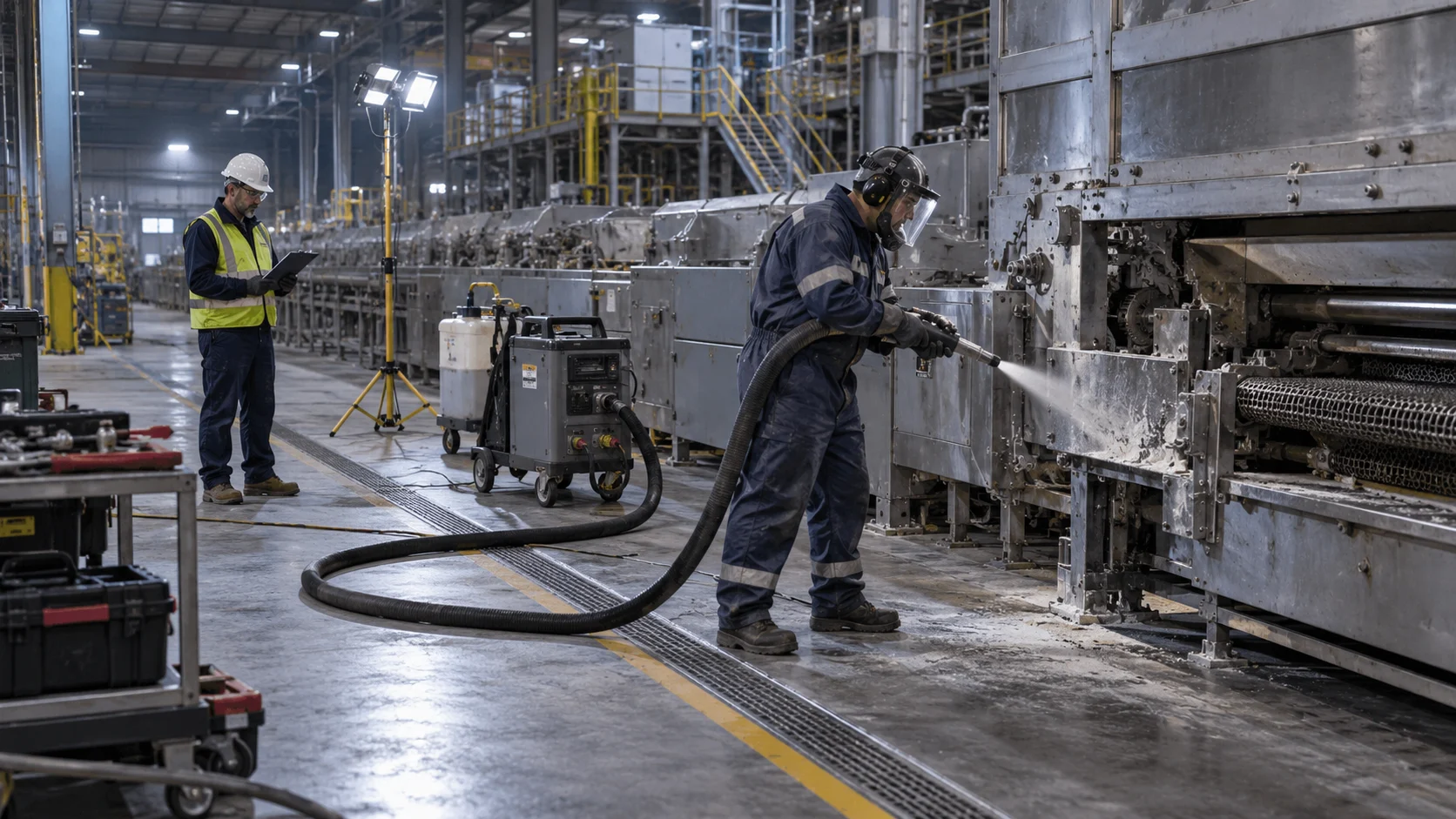
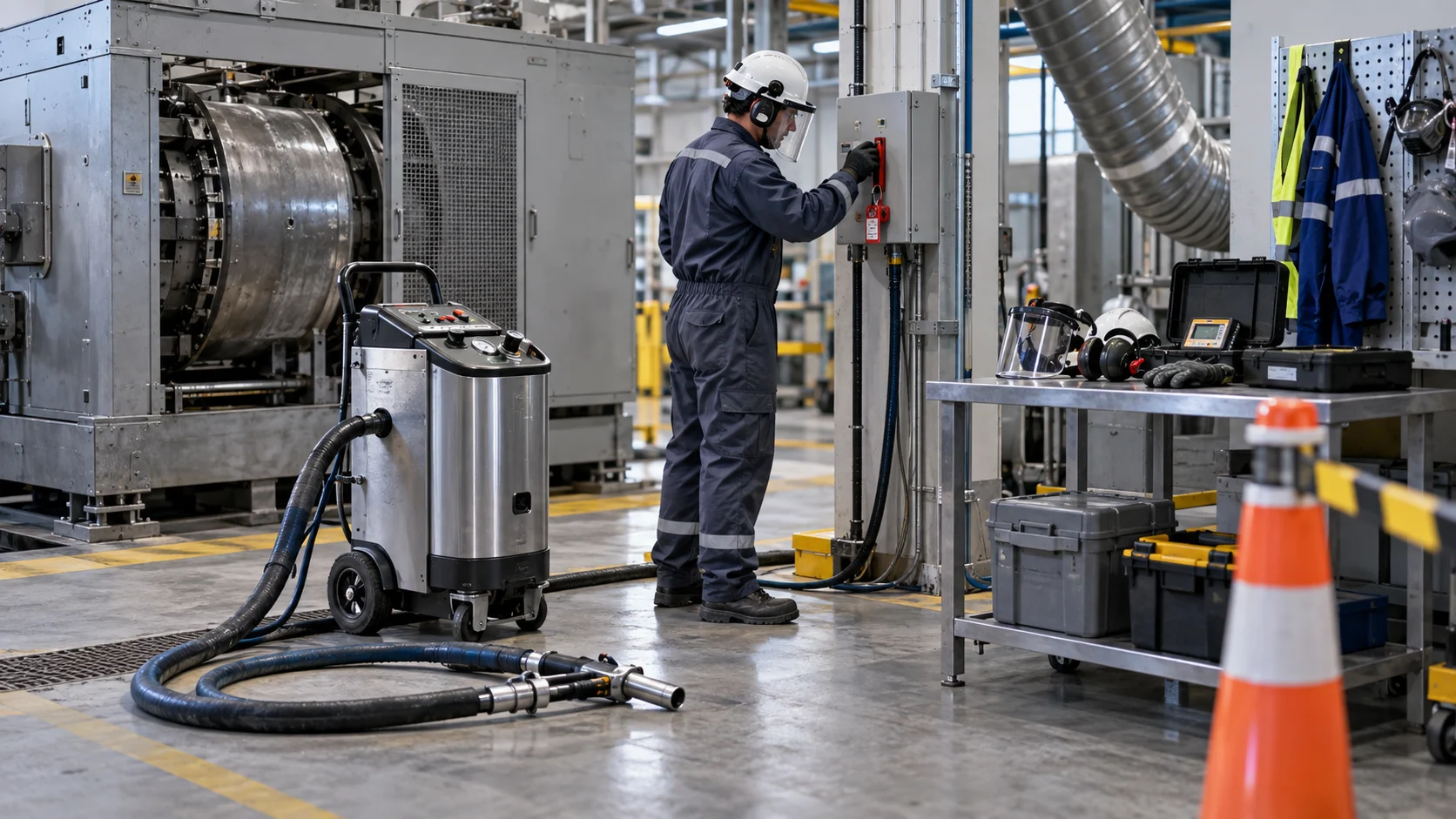
Dry ice blasting uses solid carbon dioxide that sublimates during cleaning. Cold Jet describes opportunities for in-place cleaning and reduced disassembly in suitable applications. Those are application claims from an equipment manufacturer, not a measured result for your facility. See Cold Jet’s process overview.
Next, ask these questions about the actual equipment and deposit before setting the cleaning budget.
- Can the target surfaces be reached while the equipment stays in place? Review cleaning without unnecessary disassembly.
- Which guard, cover, or component removal tasks are still required?
- How much time is needed for setup, cleaning, contaminant collection, and inspection?
- What compressed air, ventilation, and work-area controls belong in the quote?
- What result must the facility accept before the asset moves to the next task?
However, the crew still needs to collect and handle the removed contamination. Include those duties in the scope, along with the facility requirements for dry ice cleaning. If the deposit or surface response is uncertain, request a representative test cleaning before using a cleaning rate in the budget.
Count recovered production only when restart moves
First, check whether a shorter cleaning task changes the restart time. The critical path is the chain of tasks that sets the earliest return to service. Each task in that chain depends on the work before it.
Hypothetical schedule example. Cleaning finishes two hours earlier, but an unrelated repair still finishes at the original restart time. As a result, earlier cleaning recovers zero production hours in this scenario. It may give the team more flexibility, but the budget should not count two hours of extra output.
If the same two-hour reduction allows inspection and restart to finish two hours earlier, evaluate those hours against actual production demand. Therefore, count only the financial benefit the revised schedule supports.
Use the Shutdown Cleaning Window Planner to map the work window. Then follow the plant shutdown cleaning planning guide to assign access, sequencing, and handback duties.
Prepare a budget that your team can review
Finally, gather these inputs before approving the cleaning scope and plant shutdown costs.
- The priority asset list and required cleaning result.
- Confirmed equipment release and handback times.
- The production value or recovery-cost basis approved by finance.
- Contractor inclusions, exclusions, support duties, and change rates.
- Separate allowances for collection, inspection, restart, and contingency.
- Evidence for any claim that a proposed task changes breakdown frequency.
- A plan to record actual hours and costs after the work.
For recurring tasks, also discuss scheduled maintenance cleaning around suitable service intervals. Compare documented conditions and work durations over time before changing the frequency or claiming a financial return.
Questions about plant shutdown costs
Is a planned shutdown always cheaper?
Compare the actual work scopes and production effects. For example, a long planned overhaul differs from a short unexpected stop. Use a common costing method. Then explain how the events differ in duration, completed work, and lost output.
Can we use a published average downtime cost?
Use published research as context and record its industry, sample, and date. However, calculate your own production and event costs before setting a budget. Siemens focuses on large manufacturers, so its headline rates do not apply to every plant.
Does a shorter cleaning job mean a shorter shutdown?
Check the task dependencies. Count a reduction in the total outage only when the revised schedule supports an earlier approved restart. Otherwise, record the time saved in the schedule review. Also calculate any separate labor benefit.
Get a shutdown cleaning quote
Send your equipment list, deposit photographs, facility location, proposed dates, and available cleaning window. Include the required result and any known access restrictions.
Use the plant shutdown cleaning service page to review the scope, or request a shutdown cleaning quote for your next maintenance window.
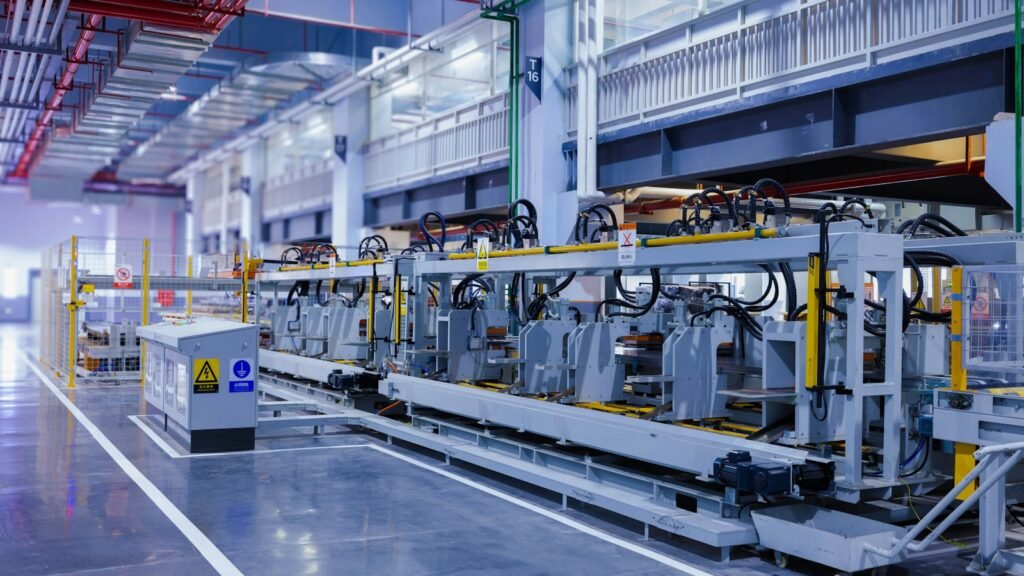
Manufacturing reference photograph by Homa Appliances on Unsplash.