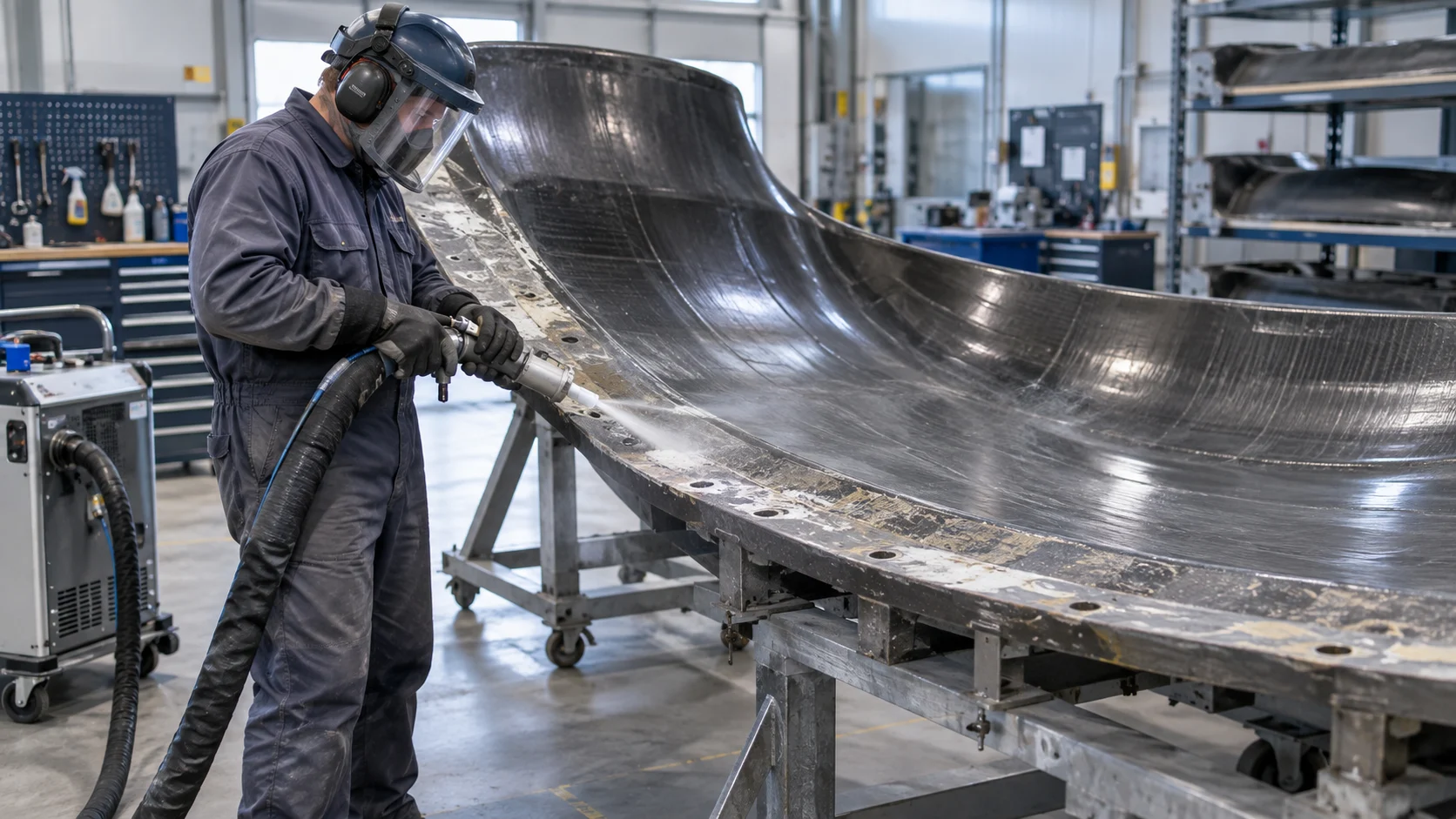
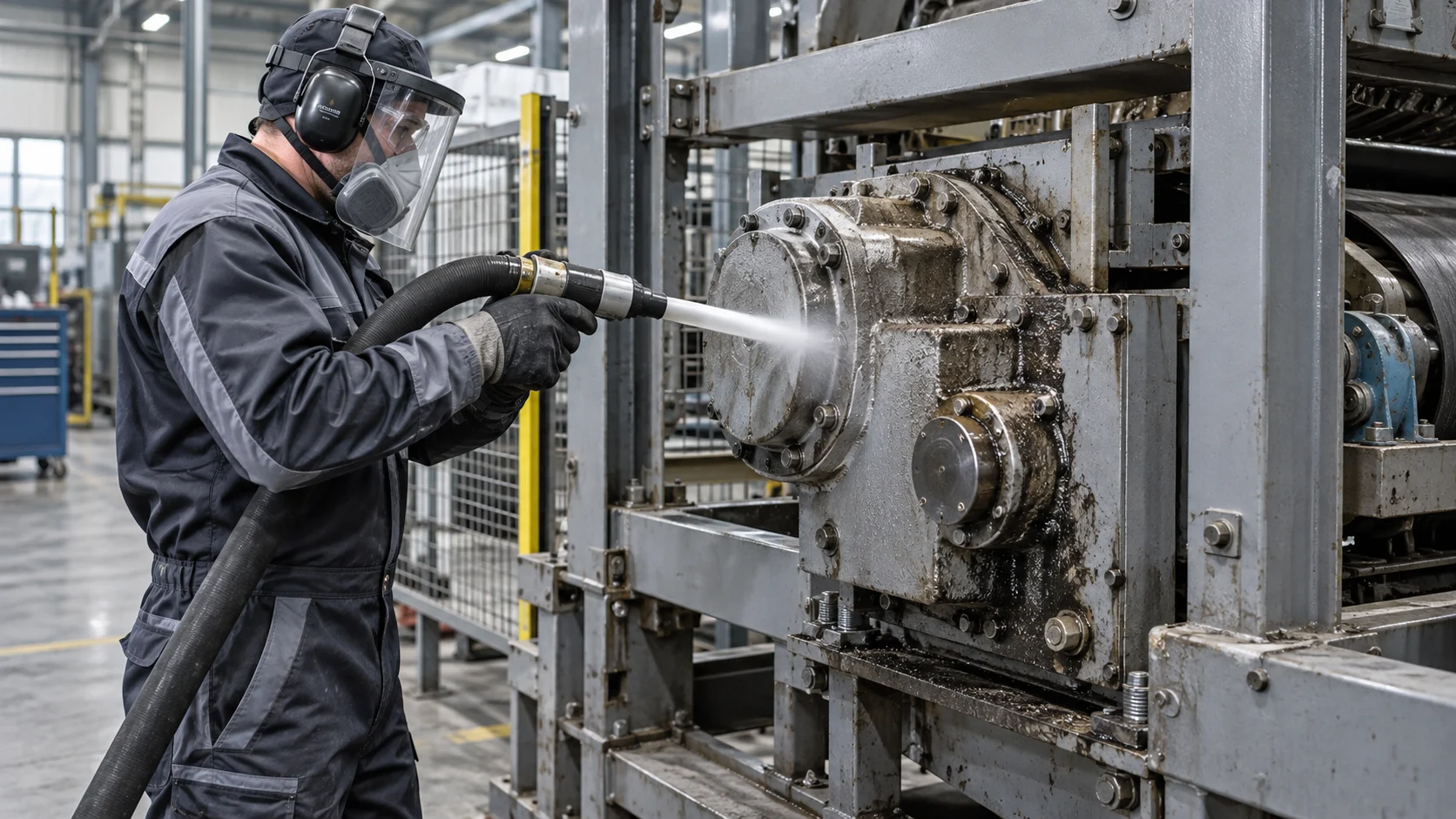
Why Choose Dry Ice Blasting for Industrial Machinery and Tooling?
Published · Updated
A practical guide to dry ice cleaning for industrial machinery and tooling, covering downtime, surface protection, cleanup, application limits, and test planning.

Dry ice blasting benefits include cleaning suitable machinery without wash water or spent blasting grit. But how much time does your current method take? First, count the cleaning, teardown, drying, and reassembly steps. Then compare the full window from shutdown to release.
Dry ice blasting for industrial machinery offers three practical advantages: it uses no wash water, leaves no spent blasting media, and can clean suitable equipment in place. These characteristics make it an alternative to solvent cleaning, manual scraping, and abrasive blasting for selected maintenance tasks. Cold Jet’s process overview.
Next, use this guide to evaluate those advantages against your machinery, tooling, deposits, and production requirements. Start with the cleaning result you need, then compare the complete job.
How dry ice blasting cleans industrial machinery
Dry ice blasting uses compressed air to propel solid carbon dioxide particles toward a surface. Particle impact and rapid cooling help loosen deposits. The dry ice then changes directly from a solid into a gas, a process called sublimation. The combination removes suitable contamination without leaving sand, glass beads, or other solid cleaning media behind. Cold Jet’s explanation of the cleaning mechanism.
The terms dry ice blasting and dry ice cleaning describe the same basic process. For a closer explanation, see how dry ice blasting works.
Five dry ice blasting benefits for machinery and tooling
1. Less dismantling can shorten the maintenance window
Some molds and accessible machine surfaces can be cleaned while they remain installed. In addition, some suitable molds can remain hot during cleaning. This can reduce removal, transport, cooldown, and reinstallation work. Cold Jet documents these applications in its plastics manufacturing guidance.
For your comparison, ask which parts actually need removal. First, identify the panels, guards, inserts, and inspection points involved. Then assign responsibility for preparation, cleaning, reassembly, and release.
However, “cleaned in place” does not authorize work on moving or energized equipment. Follow the asset’s isolation procedure and the facility’s approval requirements. Review the access questions in cleaning machinery without disassembly.
2. Non-abrasive media suits precision tooling applications
Mold cavities, vents, parting lines, and textured surfaces need careful treatment. Cold Jet identifies non-abrasive cleaning as a benefit for preserving mold details and dimensions while removing suitable release agents and production residue. Its plastic and rubber mold cleaning guidance describes these applications.
Therefore, make surface condition part of acceptance. Inspect the test area for changes to texture, coating, edges, and delicate features. Also specify what must remain on the tool, including any coating or treatment. Confirm manufacturer restrictions before selecting the cleaning setup.
For application planning, review plastic injection mold cleaning, rubber mold cleaning, and composite tool cleaning.
3. No wash water or added solvent is needed for the blasting step
Conventional dry ice blasting uses dry ice and compressed air. It does not require wash water or a solvent cleaner to carry out the blasting step. Cold Jet lists the absence of added water and cleaning chemicals among the process’s advantages. Dry ice blasting characteristics.
However, air quality still matters. Moisture carried through an inadequately treated compressed-air supply can reach the equipment being cleaned. Specify the required air capacity and treatment with the cleaning contractor, and check surface conditions before release. Cold Jet’s compressed-air guidance.
4. There is no spent blasting media to collect
Dry ice becomes gas, but the removed contamination remains. Cold Jet’s facility maintenance guidance distinguishes the sublimating cleaning media from the deposits left for collection.
Therefore, include containment, collection, and disposal in the scope. First, identify the residue and its hazards before choosing the cleanup method. Protect nearby equipment and products from displaced material.
For the full explanation, read where the dirt goes during dry ice blasting. Evaluate the benefit as less added cleaning media to manage, while retaining a plan for the actual contamination.
5. Cleaning can support tooling performance and inspection
In molding, buildup can interfere with venting and part quality. Cold Jet’s Performance Plastics case study describes deposits obstructing mold vents and reports improved venting after dry ice cleaning. Performance Plastics case study.
On machinery, removing accumulated grime can expose surfaces for visual inspection. Cold Jet includes inspection access among its facility maintenance applications.
First, set a specific objective for each asset. For example, expose an inspection point or clean a defined mold surface. Record the result against that objective before deciding whether to repeat the process.
Industrial machinery and tooling applications
Next, use the following application groups to organize an initial review. Cold Jet documents molds and composite tools in its plastics guidance, core boxes and casting tooling in its foundry guidance, and conveyors and support equipment in its facility maintenance guidance.
| Equipment or tooling | Deposits to discuss | Define before testing |
|---|---|---|
| Injection molds and composite tools | Release agents, resin residue, and process buildup | Required finish, delicate details, and approved cleaning access |
| Rubber molds | Release-agent and rubber-related buildup | Mold material, coating, vent condition, and acceptance criteria |
| Foundry core boxes and casting tooling | Binder residue, release agents, and selected refractory coatings | Vents, edges, coating requirements, and temperature restrictions |
| Conveyors, housings, and production equipment | Grease, oil, and accessible process deposits | Isolation, sensitive components, containment, and inspection points |
Bring the asset list to an industrial machinery cleaning review. For casting operations, use the more specific foundry tooling cleaning scope.
What published manufacturer examples show
At Performance Plastics, Cold Jet reports that cleaning molds in the press extended the interval between complete teardowns. The case study quotes the company’s president estimating a 200–500% increase in mold running time. It also describes lengthy heating and cooling stages associated with full teardown. These are results reported in an equipment supplier’s customer case study. Read the Performance Plastics example.
In another case study, Cold Jet describes a change at Progress Casting Group. Previously, two or three workers spent three to four hours cleaning one or two molds. Afterward, one worker cleaned a mold in about ten minutes. Preserve those different workload descriptions when reviewing the comparison. Read the Progress Casting Group example.
However, treat these examples as reasons to test the process. Establish your own baseline using the same asset, cleaning standard, and full preparation-to-release window.
Compare dry ice blasting benefits with other methods
Use this comparison as a set of questions for your maintenance team. Request an application-specific answer for each method under consideration.
| Method | Questions to resolve |
|---|---|
| Dry ice blasting | Does a test remove the target deposit at an acceptable rate? Can the surface, access, air supply, and cleanup requirements be accommodated? |
| Manual cleaning | How much hands-on work is required? Can the chosen tools reach the target areas and meet the surface acceptance criteria? |
| Water-based cleaning | Is water permitted on the asset? What collection, drying, and return-to-service steps must the scope include? |
| Solvent cleaning | Is the selected chemistry compatible with the deposit and surface? What handling, ventilation, residue, and disposal steps apply? |
| Abrasive blasting | Does the job require a surface profile or material removal? How will critical surfaces be protected and spent media managed? |
For a cost comparison, include contractor charges, internal labor, preparation, materials, waste handling, reassembly, and the production impact of the outage. Also use your own facility’s figures. Compare the total in dry ice cleaning versus manual cleaning costs.
Where dry ice blasting needs a different approach
Precision Dry Ice Cleaning’s applications and limitations guidance identifies strongly bonded coatings as potentially slow or impractical to remove with dry ice alone. It also directs heavy corrosion and abrasive surface profiling toward a different process.
Request a separate assessment for fragile finishes, thin components, seals, coatings, and electrical assemblies. Also state any inaccessible areas in the scope. For electrical equipment, follow the facility’s isolation and approval procedures and use the dedicated electrical and electronic equipment cleaning guidance.
Also confirm whether a proposed system uses dry ice alone or adds an abrasive. Specify the actual process in the quote and evaluate its surface effects and waste requirements accordingly.
Plan the work environment as carefully as the cleaning
Carbon dioxide exposure and cold contact require attention. NIOSH lists inhalation hazards and frostbite among the risks associated with carbon dioxide and dry ice. NIOSH carbon dioxide reference.
Plan ventilation and monitoring, equipment isolation, noise control, debris collection, and suitable personal protection for the actual task. First, identify nearby workers and operations. Assign responsibility for preparation and the final return-to-service inspection. Use the site’s safety and facility requirements to prepare the review.
Use a representative test to make the decision
Finally, request a test with written objectives before committing an entire line or tooling group. Include these steps in the test plan.
Use the Dry Ice Cleaning Application Review to organize the equipment, buildup, access restrictions, and questions for the test plan.
- Choose an area that represents the actual deposit, surface, and access conditions.
- Photograph the starting condition and identify what must be removed and what must remain.
- Agree on the inspection method and acceptable result with maintenance, tooling, or quality personnel.
- Record preparation time, cleaning time, material use, collection work, and remaining deposits.
- Inspect the underlying surface and note areas requiring another method or better access.
- Build the wider scope from the observed result, including exclusions and handback responsibilities.
For repeated work, use those records to develop scheduled maintenance cleaning. Review the interval against actual buildup and production needs.
Also ask operators which cleaning tasks need attention. Use our guide to industrial workplace cleaning and employee feedback to turn their observations into a defined scope.
Evaluate dry ice blasting benefits for your equipment
Which machine, mold, or tooling group would you assess first? Send Precision Dry Ice Cleaning overall photographs, close-ups of the buildup, the asset type, location, and available maintenance window. Also include any manufacturer restrictions and your required cleaning result.
Request a test cleaning or submit your equipment for a project review.